
Pickleball scoring, in full
Pickleball scoring: doubles score calls, side-out and rally
Last updated 13 October 2026
In side-out doubles, call your team’s score, the opponents’ score, then the server number. A call of 6–4–2 means your team leads six to four and is on its second server. Here is what happens after the next rally.
The short version. Choose side-out or rally scoring, singles or doubles, the game target and the winning margin. In side-out play, only the serving side scores; doubles calls add a third number for first or second server. In rally play, every rally scores and the call uses two numbers.
Side-out versus rally scoring
| Question | Side-out doubles | 2026 USA Pickleball rally doubles |
|---|---|---|
| Who scores from a rally? | Only the serving team | The rally winner |
| How many servers per possession? | Two, except the opening possession | One |
| Opening score call | 0–0–2 | 0–0 |
| Can receivers win game point? | No; they must regain the serve first | Yes, if target and margin are met |
This comparison uses USA Pickleball’s 2026 rules. Other competitions may use different rally formats.
Winning a game and match
A game finishes when one side reaches the selected target—7, 11, 15 or 21 in Picklematic—and satisfies the winning margin. Win by two means 11–10 continues; 12–10 finishes. Win by one ends at the target.
A match can be one game, best of three or best of five. Best of three ends when a side wins two games; best of five ends at three.
Side-out scoring
Only the serving side can score from a rally. A receiving-side win changes the server, but does not always transfer service across the net: in doubles, the first server normally hands over to their partner. A side-out means the other team takes over serving.
Singles
Each side has one server. Winning a rally while serving adds a point; losing it creates a side-out. The server begins from the right court on an even score and the left court on an odd score.
Doubles and the second server
Both partners normally get a service turn. After a side-out, the player in the right court serves first. If that player loses a rally, the partner serves from their existing court; neither player swaps just because the server number changes. When the second server loses, the opponents take over.
Why 0–0–2? The opening team gets only one service turn. The 2 identifies that final turn, not two points and not a second attempt at the serve. This exception resets at the start of every game.
Doubles examples: what do you call next?
Start at 6–4–1: your team is serving, with six points against four. These are separate possible outcomes, not one continuous rally sequence.
| Rally result | Next call | What changed |
|---|---|---|
| Your first server wins | 7–4–1 | Your team adds a point; the same server serves from the other court. |
| Your first server loses | 6–4–2 | No point. Your partner takes the second service turn from their current court. |
| At 6–4–2, your second server loses | 4–6–1 | Side-out. The opponents serve from the right court and call their score first. |
Opening sequence: Team A starts at 0–0–2, wins a rally (1–0–2), then loses. Team B now calls 0–1–1. B has not earned a point; it has gained the serve and has both service turns available.
Rally scoring
Under the 2026 USA Pickleball provisional rally option, the rally winner scores even when receiving. There is no requirement to serve to win the final point in that version of the rules. For example, a receiving team leading 10–9 wins the next rally and the game 11–9. Before that rally the serving team calls 9–10.
Doubles has one server per possession and a two-number score call. The next possession begins from the right court. Picklematic follows this point and service model; it does not offer a freeze or a win-on-serve switch. Confirm your event’s rules before choosing rally mode.
Is rally scoring allowed at every tournament?
No. USA Pickleball’s 2026 rulebook gives tournament directors a rally-scoring option, with exceptions: it is excluded from double-elimination doubles events, all 2026 Golden Ticket events and the 2026 National Championships. A rally setting in an app does not determine the format your tournament uses. Check the organizer’s instructions before match setup. For the standard serving-only format, follow the side-out examples above; the rally examples apply when that format is selected. See rule 15.C.2 in the official rulebook.
Targets, margins and match length
Standard recreational play usually goes to 11 with a two-point margin; official tournament formats also include 15 and 21. A 7-point target or win-by-one setting is a configurable app option, not a claim that it is an approved tournament format.
Picklematic exposes those four targets, win by one or two, and one-game, best-of-three or best-of-five match lengths. Agree the format before the first serve; tournament rules can differ.
Who serves, and from which court
The score is always called with the serving side first. Singles uses the server’s score to choose the court; doubles also tracks the service rotation within each possession.
- In singles, a lost rally transfers service. In side-out mode it adds no point; in rally mode it adds a point to the receiver.
- In side-out doubles, partners keep their positions until the serving team scores; only the serving pair switches sides after a point.
- In singles, a new server uses the court matching its score: right for even, left for odd. In doubles, every side-out starts from the right court; scoring then alternates the serving court.
- Rally scoring uses one server per side possession in Picklematic; a receiving-side rally win adds a point and transfers service.
Reading the score call
Say the serving score first. Add the receiving score second. Side-out doubles adds server 1 or 2 as the third number.
| Situation | Score call |
|---|---|
| Opening serve, side-out doubles | 0–0–2 |
| Serving side leads 6–4 on second server | 6–4–2 |
| Serving side leads 3–1 on first server | 3–1–1 |
| Rally scoring, serving side leads 8–6 | 8–6 |
| Serve crosses the net | New server’s score is called first |
Choose the format before play
Pick the scoring system, singles or doubles, match length, game target, winning margin and first server. Those choices determine when points count, when service changes and when the match ends.
Picklematic applies the same rules engine on iPhone and Apple Watch. It supports the formats above; always follow the rules set by your league or tournament.
Record the next rally on iPhone or Apple Watch
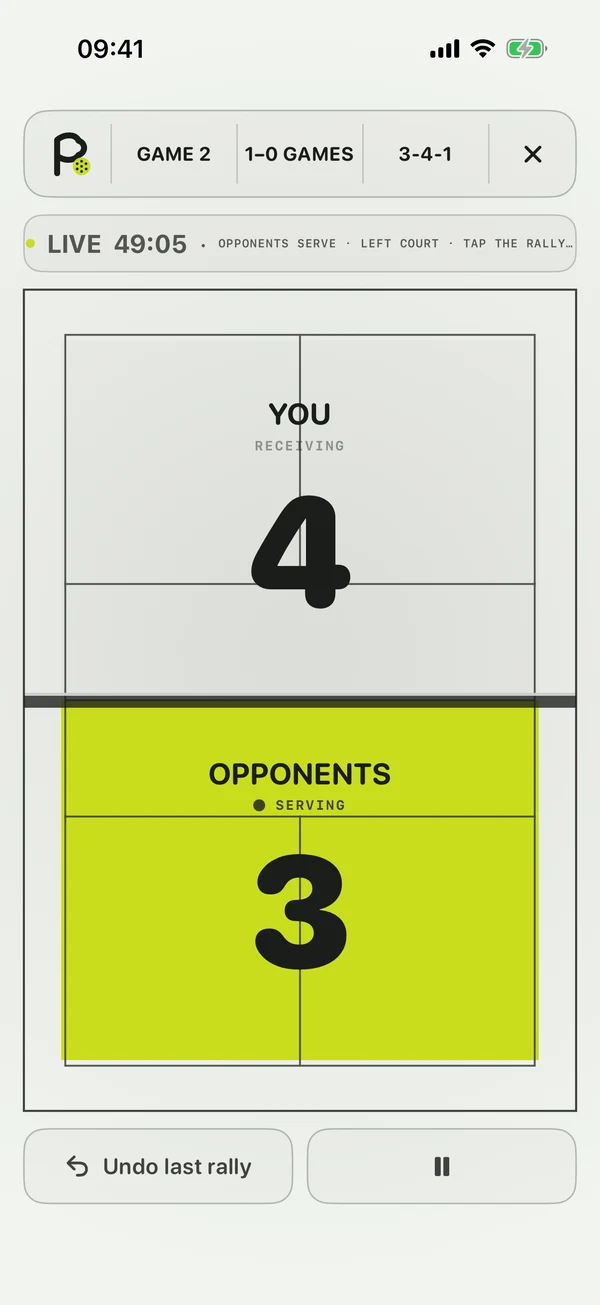
In match setup, choose Side-out and Doubles, set your target and margin, then choose the opening serving team. The score starts at 0–0–2. Tap the rally-winning team after every rally, including rallies won while receiving: the app decides whether to add a point or change the server. Its server number and serving-court indicator update with the score. Use Undo for an entry mistake during an active match.
See match setup and Apple Watch scoring
Rules and product scope
Rule explanations follow the USA Pickleball rules summary and 2026 official rulebook (sections 5, 6, 14.A and 15.C.2). The tournament exceptions in section 15.C.2 were checked on 13 October 2026. The examples illustrate ordinary rallies, without referee penalties. App options are checked against Picklematic’s current scoring implementation; the app is not an official tournament referee.